
Where Cook County Crime News Appears
Crime coverage in Chicago and the suburbs is scattered. One daily paper tracks a case for weeks. A TV station may just repost a Sheriff announcement. A neighborhood reporter might spend a whole week inside one police district. None of that is a booking feed. So none of it can stand in for the real record.
Photos vary just as much. A department might hand a newsroom a genuine booking photo. The same story could carry a portrait, a surveillance still, an agency press image, or an old file shot. Captions and source labels matter here. When a piece calls its picture a mugshot, check that claim against the named agency before you repeat it.
The Cook County record search puts the official locator, CPD search tools, records requests, court access, and custody fallbacks in one place. News is the context around those custodians. It is never a substitute for them.
Cook County News Outlets and Photos
The table reflects the local inventory of outlets. A "Photo" entry means a story may display an image. It does not mean the outlet keeps a full photo index. Before concluding anything, read the article date, the agency attribution, and any court references the story cites.
| Outlet | Coverage | Photo practice | Where |
|---|---|---|---|
| Chicago Sun-Times Crime | Chicago and suburban crime, courts, police, public safety, and occasional federal or medical-examiner context. | Varies by story. May use agency material, file images, or no photo. | Active crime section, not a roster. |
| CWBChicago | Frequent Chicago neighborhood public-safety reporting with CPD and Cook County court orientation. | Reviewed reporting labeled a CPD-supplied mugshot when one appeared. | Event reporting and newsletter coverage. |
| Daily Herald Cook County Crime | Suburban Cook arrests, charges, courts, and public-safety stories. | Story-specific; confirm venue and agency. | Cook County crime section. |
| FOX 32 Chicago | Regional reporting that can include Sheriff-provided arrest announcements. | Reviewed example used agency-provided images and named CCSO as the source. | Dated public-safety stories, not a feed. |
| ABC7 and NBC Chicago | Regional coverage, including Cicero public-safety stories. | Images and claims are story-specific. | ABC7 Cicero and NBC Cicero pages. |
| Elgin Courier-News | Elgin-area events and court context near the Cook and Kane border. | Check the county and agency before assigning the story to Cook. | Local landing path. |
| Chicago Tribune Crime | Chicago and regional criminal-justice reporting. | Coverage is not a live booking list. Apply date and disposition checks. | Ongoing crime section. |
| Official Sheriff releases | Selected investigations, public-safety events, and announcements. | Agency releases may include an image, but they are not a complete roster. | CCSO press archive. |
| Secondary booking pages | County-local or city-local entries from independent publishers. | May reproduce names, charges, and photos; can be stale or incomplete. | RecentlyBooked, Mugshots.com, and Busted Newspaper are unofficial. |
The Daily Herald Cook County crime section is one example of a local reporting channel. The capture below shows a section landing page and story context, not an official booking roster.
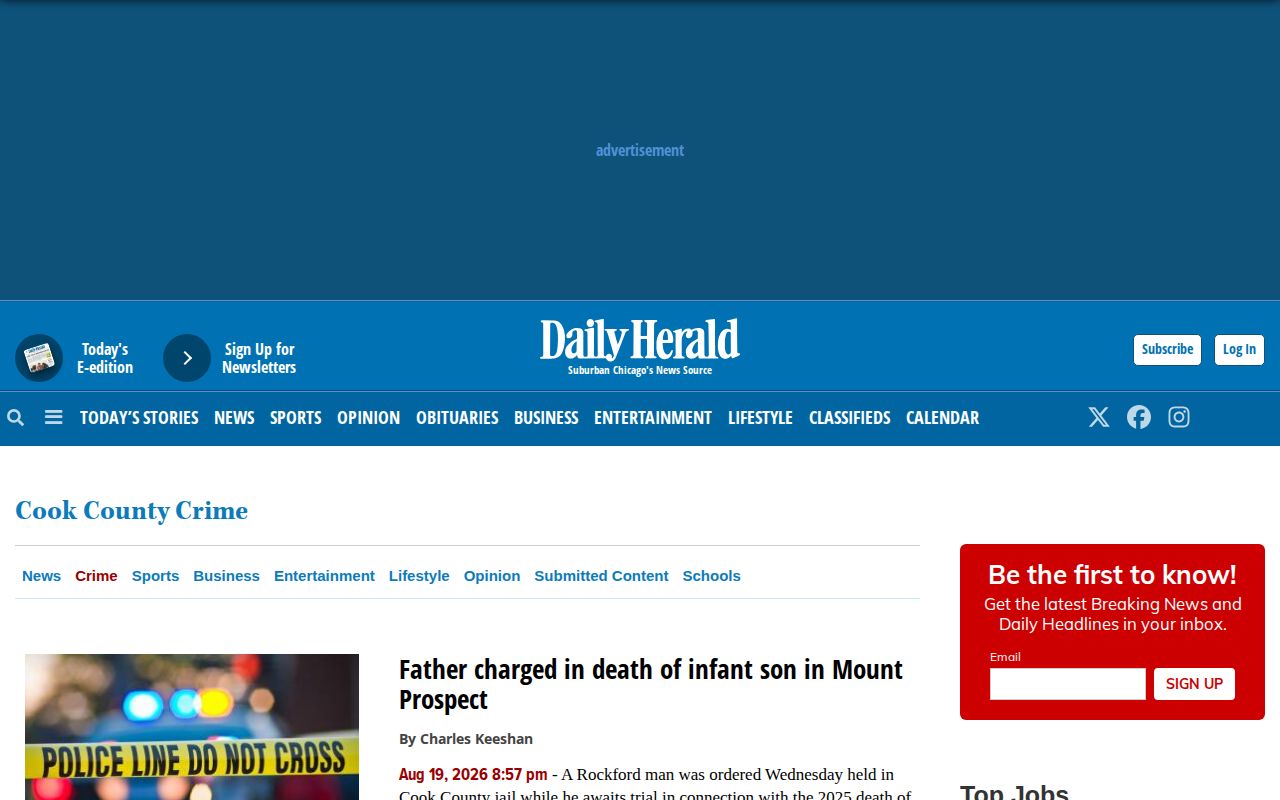
Open the live outlet for the current article, then verify its agency, date, custody status, and court outcome against official records.
Arrests.org’s Cook County page and Mugshots Zone’s Chicago page are also secondary discovery pages. A blank result on one publisher does not mean that no Cook County arrest exists, and a page that is current-looking does not prove current custody.
Elgin coverage needs an extra check because the city crosses Cook and Kane Counties. A Daily Herald or Elgin Courier-News story may be relevant to the city without belonging to a Cook County case. Chicago and Cicero stories also need the arresting agency named before a county locator is used. The city, venue, agency, and court should match.
Cook County Sheriff Releases and Social Posts
The Sheriff's press-release archive covers selected case announcements, public-safety events, and fugitive apprehensions. It is not a booking-by-booking feed. The office's Facebook, X, Instagram, and LinkedIn channels work the same way. They post chosen announcements and community news, not every new custody entry.
Illinois law limits publication of certain low-level booking photos. That limit can apply to a social post too. A post may also stay visible long after a court case changes course. So treat the agency name and publication date as source data, nothing more. For real status, follow the linked arresting agency, the CCDOC locator, or the Clerk record.
No official countywide subscription exists. Nothing promises an alert for every new arrest or booking photo. Third-party notifications and social scraping are not government alerts, and they should never be presented as such.
How Booking Photos Reach Cook County News
How does a booking photo reach a story? Usually through a police press release, a records request, a court filing, or an agency source who supplies an image. The source might be CPD, CCSO, a suburban department, or another public body. A newsroom running a photo does not turn its story into an official roster.
Illinois 5 ILCS 140/2.15 sets timing for arrest information. Agencies generally make it available as soon as practical and no later than 72 hours, with a photograph when one exists. The same statute restricts some low-level booking-photo publication on agency social networks. It does not force a photo to exist. It also does not place every local arrest into CCDOC.
Missing image or disputed caption? Ask the responsible custodian for the arrest or booking record. A newspaper correction can fix a story. It cannot touch the official case file. And an official update may never reach an old article or search result.
Cook County Jail Data Is Not Crime News
What the Sheriff posts is a daily count of who is inside the jail. It is not a booking feed. You get population totals and some context about life behind the walls, not a same-day list of names and photos. That gap matters. Cook County has no separate public blotter, so anyone hunting a fresh arrest roster has to look past the county numbers.
CPD runs an Adult Arrest Search covering adult arrests by city police. It can lag a few days while it syncs. Cicero and Elgin offer no public current arrest roster on their official pages either. For an exact record, the best route is the records process of the agency that made the arrest, not a population figure or a news roundup.
Cadence is not custody. A story that runs today may describe something that happened days ago. A roster checked today shows a person's current status, not the whole history of a case. So treat news as a pointer to a record, never as the record itself.
Whether the source is the Sheriff's archive or a TV roundup, neither replaces a booking record. When an outlet cites CCSO, CPD, or a municipal department, follow that attribution to the agency. Keep the story's publication date. A later correction or court order may never make it into the first version of an article.
From a Cook County Story to the Record
Let the story be your lead. Then work through the official custodians in order. Hang on to the story URL and its publication date, but read past the headline before drawing any conclusion about a case.
- Read the story for the arresting agency, event location, arrest date, charge language, and any central booking or case number.
- Check the matching official source: CPD for a Chicago adult arrest, CCDOC for current county custody, or the municipal police records office for Cicero or Elgin.
- Request the booking or arrest record from the agency if the web search is missing, delayed, or too narrow. Request a booking photo separately when and if available.
- Use the Cook County Clerk’s Criminal Department and case route for arraignment, bond, appearances, warrants, orders, and disposition.
- Record the result as a charge, custody status, or court disposition only when the named source supports that exact statement.
For a county-wide lookup, the home page lays out the full roster, feed, request, court, state, and federal paths. City readers get routed differently. The Chicago, Elgin, and Cicero pages point to the agency-specific record source first, then to the county custody check.
A charge can be reduced or dismissed as a case moves forward, and the court disposition is what explains the outcome.
Chicago, Elgin, and Cicero Coverage
City names can be tricky. Chicago stories usually trace back to CPD or a city court route. Cicero items belong with Cicero Police and the Town FOIA office. Elgin needs extra care. That city straddles Cook and Kane Counties, so one more county check is wise.
Three companion pages keep these boundaries straight. Chicago Busted Mugshots explains CPD's adult search and how it differs from CCDOC. Elgin Busted Mugshots keeps the Cook and Kane split visible. Cicero Busted Mugshots walks the municipal records route and the possible transfer into county custody.
A regional story can be accurate and still belong elsewhere. The venue may be another agency or county. Before calling anything a Cook County record, confirm four things. Check the venue, the arresting department, the court district, and the jail destination.