
The Cook County Most Wanted List
The Sheriff's site keeps no standing most-wanted roster. No photos, no counts, no update schedule. That gap matters more than it sounds. An old press story or a third-party gallery cannot stand in for the county's own record, and any face you see elsewhere may be stale or wrong.
Two official routes cover the same ground better. The Cook County Clerk Criminal Department handles warrant questions, and the Sheriff's crime-tip form takes tips about wanted people. Sheriff press releases sometimes report a fugitive capture or a warrant served. Those are dated announcements about one event. A notice can be pulled or changed after the fact.
What a Cook County Wanted Notice Shows
With no live roster to draw from, the fields below describe what an official notice may include, not a guarantee that every entry carries every detail. Check the publication date and the issuing agency before trusting any single item.
| Field | What it can mean |
|---|---|
| Name and photograph | An agency’s identification aid. It is not proof that the pictured person committed the alleged offense. |
| Warrant or offense information | The stated basis for the notice. The Clerk or court should be used to verify current status. |
| Description or last known area | Public-safety information that can help a tip reach the right agency. It should not be used to track or confront someone. |
| Issuing agency and date | The source and the time context. A press release is not a current warrant database. |
| Tip instructions | The approved route for information, including whether anonymous submissions are accepted and whether the route is not 911. |
A booking record and a wanted notice are not the same thing. Booking means an agency processed an arrest. A warrant is a separate court status, and a most-wanted appeal is a chosen spotlight, not a full index. Keep the three apart.
How to Read a Cook County Wanted Notice
Start with three things. Check the agency, the date, and the safety instruction. If an official page exists, use its photo and description right there on the agency site. Never lift the image into a new gallery. Never attach an unverified name pulled from an aggregator.
- Confirm that the notice is published by a Cook County agency or court, and note the date and stated reason for the notice.
- Read the caution text and tip instructions. A public notice is not permission to follow, question, photograph, or confront the person.
- If the information is useful, send it to the Sheriff’s tip form or the agency named in the notice. Use 911 only for an immediate emergency.
- For record verification, use the Clerk’s warrant resources and the official custody or arrest sources described in the Cook County booking search.
Photos belong to the official source, when one exists. Link the agency and keep the date. Skip language that overstates what a notice proves. A press release about an arrest does not settle the case.
Checking a Specific Cook County Warrant
Most active warrants never make a public-safety list. The Clerk's Criminal Department explains warrant information and branch-court duties, while the Circuit Court's local-resources page lists separate public contacts for criminal and civil warrants. Those official channels beat any name-only lookup page.
The Clerk's Master Warrant Help Guide spells out the path: warrant-case status can be searched at a courthouse digital terminal or through the authorized case-search workflow. The Clerk also notes it cannot give legal advice. Find the right branch through the court system first, then bring your specific situation to an attorney or the court itself.
- Gather the full name, date of birth, case number if known, and the county or court branch connected to the matter.
- Start with the Clerk’s Criminal Department and the Circuit Court local-resources page. The researched contacts list 773-843-4700 for criminal warrant information and 312-603-6475 for civil warrant information.
- Use the authorized case-search or courthouse terminal process described by the Master Warrant Help Guide. Record the access date because a case status can change.
- Do not approach the person or try to avoid service. Ask the court or an attorney about lawful next steps, and use 911 for an immediate safety emergency.
A warrant check is not a jail-roster check. A person can have an active warrant while walking free. Someone in CCDOC custody may have a warrant already folded into a court case. The Clerk and the Sheriff each answer a different half of the question.
Bring a case number and court branch when you can. Common names can pull up multiple cases. A public result may also miss a later recall or quash order. The Clerk's process finds the case; it does not replace legal advice.
Cook County Warrant Types and Sources
Each warrant path in the table below serves a different purpose. Verify anything you find with the court, since a public label may not reflect every later order.
| Record or status | Where to begin |
|---|---|
| Criminal warrant | Cook County Clerk Criminal Department and the criminal-warrant contact listed by the Circuit Court. |
| Civil warrant | The Circuit Court local-resources contact for civil warrants, not the criminal booking roster. |
| Bench or court-issued status | The branch court and case record. Ask the court or an attorney about the individual case. |
| Fugitive or wanted notice | The issuing agency’s dated public-safety notice and the Sheriff’s tip route. |
| Booking or custody result | The arresting agency or CCDOC locator. It does not prove an active warrant or case outcome. |
Who keeps the record often matters more than the legal label. A live warrant question goes to the court or an authorized clerk. A report about a warrant served goes to the issuing agency. A custody question goes to the jail or police.
A warrant entry may stem from a complaint, a missed court date, or some other court action. The public label rarely tells the whole story. Read the docket or ask the court before assuming a status still holds. Charges get changed, cases get dismissed, and later orders can undo an earlier entry.
Cook County Tips, Safety, and Crime Stoppers
The Sheriff’s crime-tip form accepts information about wanted individuals and ongoing investigations. It allows an anonymous or identified submission, sends the report to the Intelligence Center, and warns that it is not 911 and is not likely to trigger immediate dispatch. For an immediate emergency, call 911 instead.
The Sheriff’s “How Do I” page lists Crime Stoppers at 800-535-7867. The researched material does not support promising a reward for every tip. If a specific official notice states a reward, follow that notice’s terms and do not assume the same offer applies to another case.
The official Cook County Sheriff crime-tip form is the safe reporting route for wanted-person information. The capture below shows the form’s emergency warning and report options, not a most-wanted gallery.
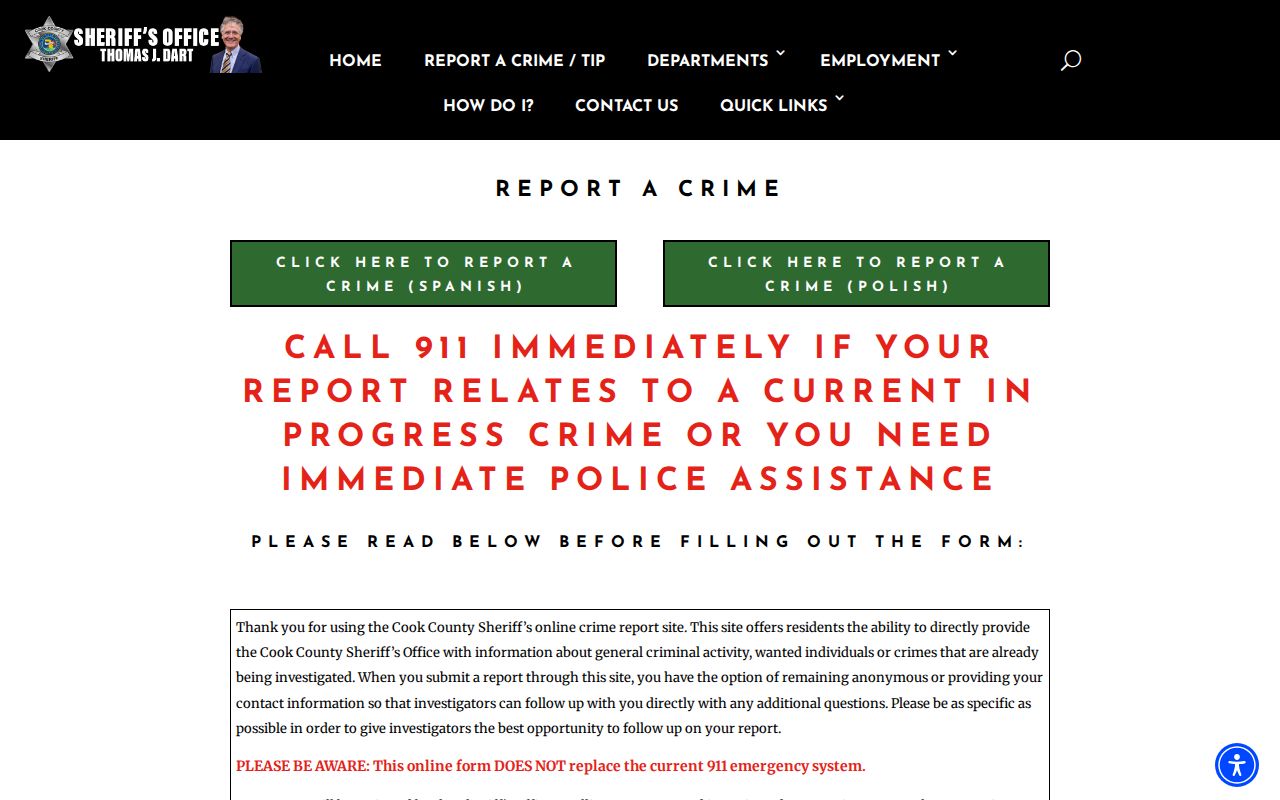
Use the live form for the current instructions and never use a tip page to confront or identify someone yourself.
Do not confront a wanted person. Keep your distance and say nothing about recognizing anyone. Send what you know through the agency’s official tip route instead. Photos can be old, and the face in one may not be the right face at all.
What if the name is familiar? Recognition is a reason to pick up a tip channel, not proof you have the right person. Shared names are common. So are old photographs and social posts that point at someone else entirely. Let law enforcement sort out who is who.
Cook County Tip Routes
Report a wanted person through the Sheriff’s official crime-tip form, which accepts anonymous or identified submissions and routes them to the Intelligence Center.
Crime Stoppers: 800-535-7867, listed on the Sheriff’s How Do I page. That number is not 911. Reserve 911 for emergencies happening right now.
Press Releases Are Not a Live Warrant List
The Sheriff's press-release archive sometimes carries fugitive arrests, warrant-service news, or public-safety requests. Each entry is tied to one date. Each one covers a single event. So treat it as background, not a running index of Cook County warrants.
Social media shares the same weakness. Posts push selected announcements and community updates. They skip most bookings and warrants. Illinois law also restricts how agencies post certain low-level booking photos on social platforms. The court's own record remains the authority.
Old notices can still surface in search results. Check the issuing agency first. Check the date too. Then follow the Clerk's current case path, since a later court order may never appear in that old post.
From a Wanted Notice to the Record
A public notice opens a search rather than closing it. An arrest may have left records in two places. The arresting agency holds one file, and the county locator holds another. Once a case reaches court, the Clerk can show the complaint, warrant, bond, appearances, and later orders.
Booking searches carry their own custody rules. Someone released after bond court may never show up in CCDOC at all. A current roster result says nothing about whether charges will be reduced or dismissed later. Follow the Cook County record and custody search first, then the Clerk's case route for what the court has done.
Dignity applies at every step. A wanted notice is a safety notice. A booking is one event in a longer process. Only the court record tells you how a case ends.